The morning of Friday, April 10, 2026, started like any other holiday morning at El Balcon de Santa Ana. Suitcases were wheeled through the lobby of the clifftop hotel in Playa de Santiago, the air smelled of coffee and sunscreen, and 27 British tourists gathered for checkout. They were due at San Sebastián, La Gomera’s capital, to catch the morning ferry to Tenerife. Another island, another adventure. The kind of seamless transfer tour companies promise when you book an island-hopping break in the Canaries.
They boarded a white Gomera Tours coach parked in the turning circle. The driver, a local man who knew these roads, did his walkaround and took the wheel. By 9:15 a.m., they were rolling.
La Gomera isn’t like Tenerife or Gran Canaria. It’s smaller, wilder, older. A volcanic plug in the Atlantic, cut through with ravines called _barrancos_ and a road network that clings to the mountainsides in tight, unforgiving loops. The GM-2 is one of its main arteries — a ribbon of asphalt that drops 3,000 feet from the highlands to the coast. Locals drive it every day. Tourists call it beautiful and terrifying in the same breath. “Like taking your life in your hands,” one British holidaymaker had posted on a travel forum last year.
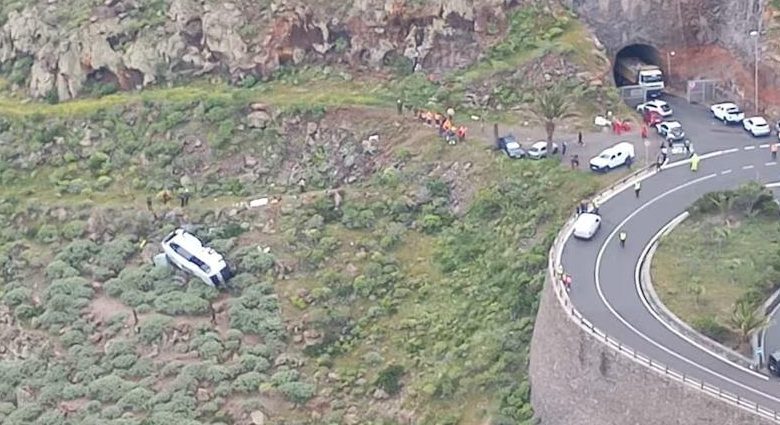
About 20 minutes out of Playa de Santiago, just past the El Revolcadero Environmental Centre, the road tightens into a hairpin bend. Below it, the ground simply falls away — dry scrub, loose rock, and a 100-meter drop to the next ledge.
No one on the bus saw it coming. Passengers were dozing, scrolling, watching the ocean flash between laurel trees. Then the engine note changed. The driver felt it first: the brake pedal going soft, then nothing. He pumped. The coach kept rolling, picking up speed on the downhill gradient. He shouted. Some thought he was warning about a sharp turn. Then the bus didn’t turn.
In the seconds that followed, the driver made the only choice he could. He wrenched the wheel left, aiming for a dirt turnout that peeled off the main road. If he could scrub speed in the gravel, maybe he could stop before the edge. The coach lurched, tilted, and for a moment the dirt held. Then the nearside wheels found air.
Witnesses from a hiking path below said it didn’t look real. The bus seemed to hang for half a second before it dropped, rolling once, twice, before coming to rest on its side against a cluster of rocks, halfway down the ravine. Dust rose in a column, marking the spot.
The silence after was brief. Then came screaming, and the hiss of a fractured radiator, and the sound of glass still falling.
The 112 Canary Islands emergency line logged the first call at 9:41 a.m. “_Autobús despeñado en GM-2_.” Bus over the edge on GM-2. Within minutes, La Gomera’s entire emergency apparatus was moving. Fire crews from San Sebastián, Guardia Civil traffic units, and every available ambulance on the island turned onto the narrow road. Two helicopters — one from Tenerife South, one from the GES air rescue group lifted off.
Getting to the bus was the first battle. The terrain is why La Gomera is a UNESCO Biosphere Reserve, and also why it’s a nightmare for rescuers. There’s no shoulder on the GM-2. No easy way to get heavy equipment down a near-vertical slope. Firefighters rigged ropes and descended on foot. Paramedics followed, carrying backboards and trauma kits.
Inside the coach, 28 people were trapped in a space that was no longer shaped like a bus. The driver was conscious, wedged by the steering column. He kept repeating, in Spanish, that the brakes had failed. Of the 27 British tourists, one man seated near the front on the drop side had taken the worst of the impact. He was unresponsive. Others were bleeding, confused, some still strapped in seats that now hung from the ceiling.
Extrication took hours. The most critical three were packaged and lifted out by helicopter first, flown straight to Hospital Universitario in Tenerife. The rest were brought up the slope by hand, passed from firefighter to paramedic to ambulance. All 27 injured went through the doors of Hospital Nuestra Señora de Guadalupe in San Sebastián de La Gomera. The man at the front did not make it. He was pronounced dead at the scene.
By 2:00 p.m., local authorities released the first hard numbers: 28 occupants, 27 British nationals and one Spanish driver. One deceased, 27 injured, three of them serious.
The Aftermath
At El Balcon de Santa Ana, the mood collapsed. Staff who had waved the group off two hours earlier now fielded calls from the UK. The hotel manager confirmed to reporters: “They had left the hotel to head to Tenerife on the ferry. They were all British.” Luggage that hadn’t made the bus sat in the lobby, tagged and waiting for owners who were now in trauma wards.
On the GM-2, the wreckage stayed in place as Guardia Civil traffic investigators began their work. They marked the road, measured skid lines, and took the driver’s statement. “The brakes weren’t responding,” he told them. The coach, owned by Gomera Tours, was impounded for a full mechanical inspection. The company, which runs excursions and transfers across the island, suspended all operations for 48 hours.
The news hit the UK by midday. The Foreign Office said it was “supporting the family of a British man who died in La Gomera and providing consular assistance to injured nationals.” Names were withheld until families were notified.
Canary Islands president Fernando Clavijo posted on X: “Following the accident of a bus reported in La Gomera and the work of the emergency teams who are intervening at this moment. My support to the victims and their families.” Minister for Territorial Policy Angel Victor Torres added: “Tragic news in La Gomera, with the confirmation of one person deceased. Very attentive to the actions in these first moments of the emergency services and the healthcare personnel. With a heavy heart. May there be no more victims.”
The Road’s History
For people on La Gomera, the location punched like a bad memory. In May 2025, less than a year earlier, another tour bus overturned on the same stretch of GM-2. A 73-year-old woman died, 11 others were hurt. After that crash, island officials promised a safety review of tourist transport and road barriers. Residents say little changed. The GM-2 still has sections with no guardrail, just a low stone wall and then the drop.
“Every time I drive that bend I pray,” said one taxi driver from San Sebastián, who didn’t want to be named. “The views are beautiful. But if something goes wrong, there’s nowhere to go.”
Gomera Tours had a clean public safety record until today. Their website advertises “modern fleet, experienced drivers.” The bus involved was a 54-seat Scania, five years old, according to registration data. Whether brake failure was mechanical, maintenance-related, or something else will be the core of the investigation. The Guardia Civil’s traffic unit and a judge from San Sebastián have opened a case.
Evening on La Gomera
By nightfall, the ravine was quiet again except for floodlights around the wreck. The three critically injured patients were stable but guarded in Tenerife ICUs. The other 24 were being treated for fractures, lacerations, and shock in La Gomera. The British consulate had staff at the hospital. The deceased man’s body was moved to a mortuary in San Sebastián.
At the port, the ferry to Tenerife left on time. It was half empty.
The GM-2 reopened at 8:30 p.m. to single-lane traffic, controlled by police. Drivers slowed at the bend, looking down where the dirt was still churned and the scrub was flattened. There was no barrier there. Just a drop, and now, a reason for one.
The island will run on tourism again tomorrow. It has to. But for 27 families in the UK, for one driver who will replay that soft brake pedal for the rest of his life, and for one family who won’t get a phone call back, April 10, 2026, will always be the day the road took more than it gave.