
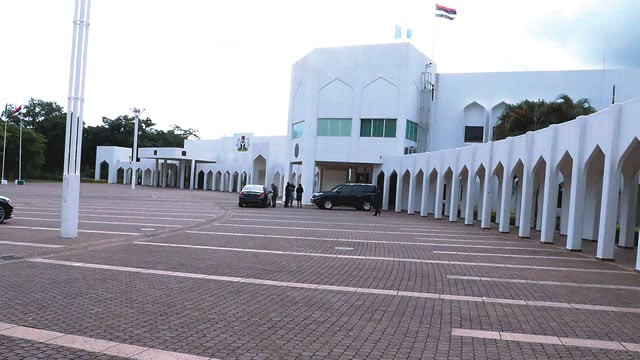
The Aso Rock Presidential Villa is on track to completely switch over to solar power by March 2026. Temitope Fashedemi, the State House Permanent Secretary, announced that once the solar power project is finished, the Villa will no longer rely on the national electricity grid.
Fashola shared this information during a budget defence before the Senate Committee on Special Duties at the National Assembly in Abuja on Wednesday. Details of the proceedings were sent to State House reporters that evening.
He mentioned to the committee, headed by Senator Kaka Lawan (Borno Central), that the solar installation wrapped up near the end of 2025 and has been undergoing tests since December.
Fashedemi stated, We’re hoping to fully switch over, possibly by March. He added that this change would save the government a lot of money.
He used the State House Medical Centre as an example of how well the project can work.
He explained that the Medical Centre installed its own solar system in May 2025 and has been running entirely without generator power since then.
He noted, “Since May last year, the generator at the State House Medical Centre hasn’t been used at all. For only a couple of months, we got three per cent of our power from AEDC (Abuja Electricity Distribution Company), with the rest coming directly from solar and battery electric storage.”
In 2025, the Federal Government set aside N10 billion for the Solarisation of the Villa with Solar Mini Grid project.
This decision drew criticism from many Nigerians, who felt that installing solar panels at Aso Rock suggested that the administration couldn’t fix the country’s unreliable power supply.
The 2026 budget includes an additional N7 billion for the project.
However, Mustapha Abdullahi, the Director-General of the Energy Commission of Nigeria, defended the project in April 2025. He said it wasn’t sustainable for the Villa to keep paying about N47 billion in annual electricity bills.
Bayo Onanuga, the Special Adviser to the President on Information and Strategy, also pointed out that the White House uses solar energy to support the initiative.
Before deciding to switch to solar, the State House had electricity debts close to N1 billion.
In February 2024, AEDC listed the Presidential Villa as one of the top government debtors, with an outstanding bill of N923.87 million.