UK Weather: Polar Vortex Fears Raise Questions Over Possible Arctic Freeze
Experts monitor polar vortex developments as colder Arctic air could increase the risk of a sharp temperature drop across parts of the UK.

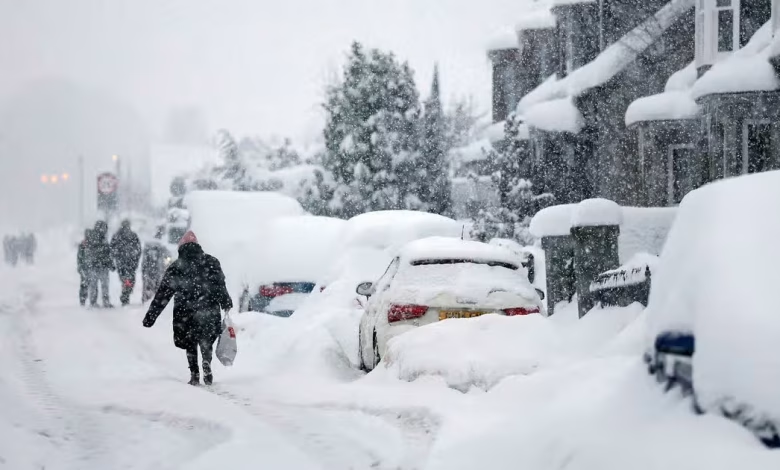
Britain could face a sharp change in weather conditions in the weeks ahead as attention turns to the behaviour of the Arctic polar vortex and its potential influence on the UK’s winter weather.
Recent reports have raised concerns that changes in the polar vortex could increase the possibility of colder Arctic air reaching parts of the UK. However, meteorologists have stressed that a polar vortex disturbance does not automatically mean a widespread freeze or heavy snowfall.
The Met Office explains that the stratospheric polar vortex is a large circulation of cold air around the North Pole during the Northern Hemisphere winter. If the vortex weakens, the jet stream can become more distorted, potentially increasing the chance of colder northerly or easterly air reaching the UK.
No widespread Arctic freeze confirmed
Despite the growing speculation, the latest Met Office outlook does not currently show a confirmed widespread Arctic freeze.
The UK’s latest forecast points towards changeable conditions into early October, with periods of rain, showers and strong winds. Temperatures are currently expected to remain above average overall during parts of the longer-range period.
The Met Office has previously warned that headlines based on individual weather-model runs can exaggerate the certainty of potential cold spells. Longer-range forecasts carry considerably more uncertainty than short-range forecasts.
What could happen this winter?
A weakening polar vortex or a sudden stratospheric warming event can sometimes influence the jet stream and increase the potential for colder outbreaks over the UK. However, the effect is not automatic, and any resulting cold spell would depend on how the atmosphere responds.
For now, people across Britain are being advised to follow official forecasts as the winter pattern becomes clearer rather than relying on early predictions of an extreme freeze.
The Met Office says detailed, location-specific forecasts and warnings are the most appropriate source for assessing severe weather risks as they develop.