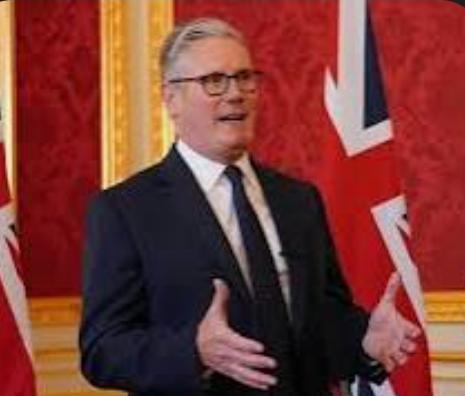
British Prime Minister, Keir Starmer, has insisted he is going nowhere despite mounting pressure within the Labour Party following a humiliating showing in the U.K. local elections.
Speaking after Labour suffered its worst local election result for a ruling party in more than 30 years, Starmer declared that his government remains a “10-year project” and vowed to stay on as Prime Minister.
The election fallout has triggered open rebellion inside Labour, with several lawmakers now demanding his resignation after the opposition Reform U.K. made major gains across the country.
Former Minister, Catherine West, escalated the crisis by threatening to rally MPs behind a leadership challenge unless Starmer’s cabinet moves against him before Monday.
Under Labour Party rules, at least 20 percent of Labour lawmakers — equivalent to 81 MPs — would be needed to trigger a formal leadership contest. So far, around 30 MPs have publicly questioned Starmer’s leadership.
In an interview published by the Observer on Sunday, Starmer dismissed speculation about stepping down and confirmed he plans to lead Labour into the next general election.
“I’m not going to walk away from the job I was elected to do in July 2024,” he said. “I’m not going to plunge the country into chaos.”
If Starmer were forced out in the coming weeks, Britain would end up with its seventh prime minister in just 10 years.
Despite Labour’s heavy losses, Starmer’s cabinet has largely remained loyal. Education Secretary, Bridget Phillipson, admitted voters had delivered Labour “a real kicking” but said the Prime Minister would unveil a “fresh direction” for Britain during a major speech on Monday.
West, who served as a junior Foreign Minister before being dismissed by Starmer last year, said she would wait to hear the speech before deciding whether to formally launch a leadership bid against him.
Meanwhile, some members of Labour’s left wing have urged colleagues not to rush into removing Starmer. Veteran MP, John McDonnell, warned that unnamed figures within the Party were trying to exploit the unrest to force an early leadership contest.
Another Labour MP, Ian Byrne, cautioned that a rushed contest could be manipulated by powerful figures within the Party establishment.
Speculation has also intensified around Andy Burnham as a possible replacement for Starmer. However, Burnham is currently not a member of parliament, making him ineligible to contest an immediate leadership race.
Starmer is required to call the next U.K. general election by 2029. If he survives politically and wins another full term, he would become Britain’s third-longest continuously serving Prime Minister in the last 200 years, behind Margaret Thatcher and Tony Blair.