
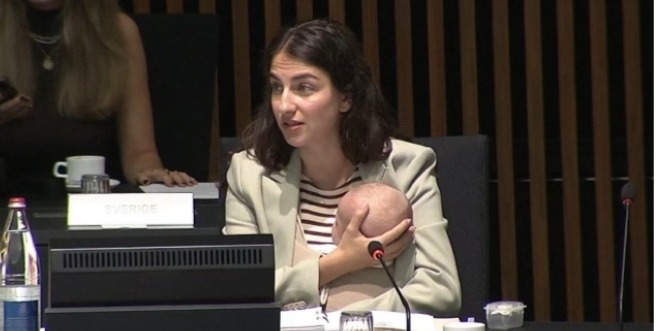
Sweden’s Environment and Climate Minister, Romina Pourmokhtari, made headlines across Europe on Thursday after arriving at a high-level European Union meeting with her three-month-old son strapped to her chest, in a move that challenged long-standing norms about motherhood and public office.
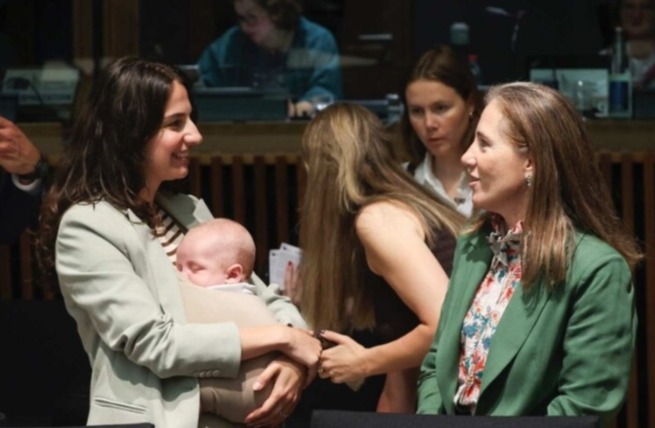
The 30-year-old Minister attended the EU environment ministers’ meeting in Luxembourg accompanied by baby Adam, while an aide followed closely behind with a stroller, creating what officials believe is a first in the history of ministerial meetings within the European Union.
Pourmokhtari said her decision was intended to send a clear message that women should not be forced to choose between raising a family and serving in public office.
“Happy also to be an example of not having to choose between being a present minister and a present mother,” she told reporters as her son rested peacefully in a baby sling during the talks.
“There are many things that make Europe a wonderful place to live. One of them being just this, that we can have the possibility of attending meetings and attending to my child.”
The moment quickly attracted attention from fellow ministers and officials attending the meeting, with French counterpart, Monique Barbut, presenting the Swedish Minister with a gift for the baby.
European Union officials later said they believed it was the first time a child had been brought into one of the bloc’s ministerial meetings.
The development has reignited discussions across Europe about the challenges working mothers face in balancing career ambitions with childcare responsibilities.
Studies have consistently shown that women often experience setbacks in career progression, promotion opportunities and earnings after becoming mothers, a phenomenon commonly referred to as the “motherhood penalty.”
In recent years, European institutions have introduced measures aimed at making political life more accessible to parents. The European Parliament recently amended its internal rules to allow new mothers to vote by proxy during maternity leave.
Pourmokhtari’s appearance also joins a growing list of moments in which female political leaders have publicly highlighted the realities of motherhood while serving in office.
In 2018, former New Zealand Prime Minister, Jacinda Ardern, made global headlines when she brought her three-month-old daughter, Neve, to the United Nations General Assembly, marking the first time a baby attended the gathering in the organisation’s history.
A year earlier, Australian Senator, Larissa Waters, became the first woman to breastfeed her newborn child inside the Australian Parliament while carrying out official duties.
Ardern also made history as only the second serving prime minister to give birth while in office, following former Pakistani Prime Minister, Benazir Bhutto, who welcomed a child in 1990 while leading her country.
For many observers, Pourmokhtari’s decision represented more than a personal choice — it was seen as a powerful statement about modern leadership, workplace inclusion and the changing expectations surrounding parenthood in public life.