
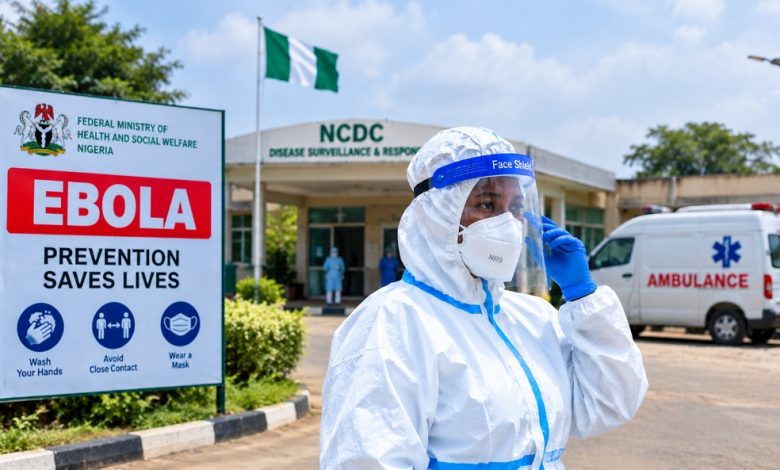
The World Health Organization (WHO) has urged Nigerians to remain calm following confirmation of an imported case of Ebola Bundibugyo virus disease in Abuja, stressing that the discovery of one case does not automatically mean the country is experiencing an outbreak.
Nigeria’s Federal Ministry of Health and Social Welfare announced the laboratory-confirmed infection on Tuesday, 20 October 2026, after a woman with a recent international travel history was diagnosed at a private health facility in the Federal Capital Territory.
The patient is receiving medical care in isolation, while public health authorities intensify efforts to identify and monitor individuals who may have been exposed to the virus.
According to the WHO, 44 contacts had been identified as of the initial announcement. The monitoring exercise forms part of a coordinated response involving the Nigeria Centre for Disease Control and Prevention (NCDC), the Federal Ministry of Health and Social Welfare, the FCT health authorities and international partners.
The investigation is examining the patient’s movements and possible exposure to the virus. Although the woman had travelled through Uganda, authorities have yet to establish the precise location where she contracted the infection. Her travel history alone does not confirm where the exposure occurred.
Health officials have also strengthened infection prevention and control measures at the hospital where the patient initially received treatment. Contact tracing and surveillance remain central to efforts to detect any additional infections at an early stage.
In a message issued on Wednesday, 21 October, WHO Regional Director for Africa, Mohamed Janabi, cautioned against panic and misinformation, reiterating that the confirmation of a single imported case should not be interpreted as proof of widespread transmission within Nigeria.
The reassurance comes as the Bundibugyo virus outbreak in the Democratic Republic of the Congo continues to pose a regional public health challenge. Kenya has also reported cases associated with the wider outbreak, prompting neighbouring and other African countries to strengthen preparedness and surveillance.
Ebola Bundibugyo virus disease is a severe illness that requires prompt diagnosis, appropriate medical care and rigorous infection prevention procedures. The virus can spread through direct contact with the blood or other bodily fluids of an infected person who has developed symptoms, as well as through contaminated materials.
The WHO continues to emphasise early detection, laboratory testing, careful monitoring of contacts and protection for healthcare workers as essential elements of an effective response. It has also advised against imposing travel or trade restrictions on affected countries in connection with the current event.
Nigeria’s response is being closely watched because of the country’s experience containing Ebola during the 2014 outbreak. Public health authorities are now seeking to prevent further transmission through coordinated investigations, surveillance and timely communication with the public.
Residents are encouraged to obtain information from the NCDC, the Federal Ministry of Health and Social Welfare and the WHO. Anyone who suspects a possible exposure should seek prompt guidance from qualified health professionals rather than relying on unverified social media reports.
As the investigation progresses, the priority remains clear: establish the extent of possible exposure, monitor identified contacts and prevent the imported infection from spreading further.