Inside the Plot: FBI Says Michigan Synagogue Attacker Was Inspired by Hezbollah.

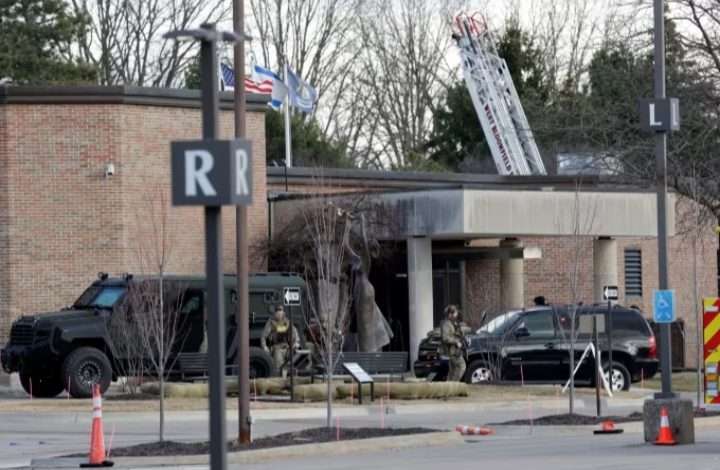
U.S. authorities have revealed chilling details behind the violent attack on a synagogue in West Bloomfield, Michigan, earlier this month, describing it as a terror incident allegedly inspired by the Lebanese militant group Hezbollah.
According to the Federal Bureau of Investigation (FBI), the suspect deliberately targeted the Jewish community and what is believed to be the largest Jewish temple in the state of Michigan.
Investigators identified the attacker as Ayman Ghazali, a naturalised U.S. citizen originally from Lebanon. Authorities say he rammed a pickup truck into the synagogue on March 12 while more than 100 children were attending classes inside the building.
Officials disclosed that Ghazali had been waiting in the synagogue’s parking lot for over two hours before suddenly driving the truck deep into the facility. During the incident, the vehicle struck a security officer before becoming stuck inside a hallway.
Armed security personnel at the synagogue responded immediately, exchanging gunfire with the attacker. The confrontation ended when Ghazali shot himself inside the truck.
Amid the chaos, the vehicle’s engine compartment caught fire, causing extensive damage to the building. Investigators later discovered that the truck had been loaded with more than $2,000 worth of commercial-grade fireworks and roughly 35 gallons of gasoline, which authorities believe were intended to intensify an explosion.
Jennifer Runyan, the FBI’s special agent in charge in Detroit, said the materials were meant to “enhance” the destructive impact of the attack.
Despite the scale of the plot, no one else was killed. However, one of the temple’s lead security officers suffered injuries after being struck by the vehicle.
Authorities say Ghazali appears to have acted alone. Runyan confirmed there is currently no evidence suggesting he had accomplices.
Jerome Gorgon, the U.S. Attorney for the Eastern District of Michigan, said that if Ghazali had survived, he would have faced charges of providing material support to Hezbollah, which is widely designated as a terrorist organisation.
According to Gorgon, investigators believe the attacker was heavily influenced by propaganda linked to the group.
Officials also revealed that Ghazali had previously appeared in federal databases because of connections to individuals linked to suspected Hezbollah networks.
The case also took a personal turn just days before the attack. Authorities said members of Ghazali’s family in Lebanon – including two brothers – were killed in an Israeli airstrike as tensions between Israel, United States and Iran escalated in the region.
The Israeli military later stated that one of his brothers, Ibrahim Muhammad Ghazali, was a Hezbollah commander responsible for managing weapons operations within the group’s Badr unit.
Investigators say the attack had been planned days in advance. A review of Ghazali’s online activity revealed repeated visits to pro-Hezbollah and Iranian media outlets, as well as searches related to weapons and ammunition.
Beginning around March 9, authorities say he closely followed speeches by Naim Qassem, Hezbollah’s secretary-general, while also researching Jewish institutions and community events across the Detroit metropolitan area.
His search history included phrases such as “largest gathering of Israelis in Michigan,” “Orthodox synagogues,” and “Israelis near me,” according to investigators.
Authorities say Ghazali eventually purchased an AR-style rifle, multiple magazines and hundreds of rounds of ammunition from a gun store in Dearborn Heights after two other individuals refused to sell him a weapon.
In the days that followed, he practised firing the weapon and purchased fireworks and fuel. Investigators said he also ordered dozens of containers and filled them with gasoline, making several separate trips to gas stations to avoid drawing suspicion.
On the day of the attack, Ghazali reportedly sent multiple messages and videos to his sister – believed to be living in Lebanon – expressing support for Hezbollah’s ideology.
Just minutes before driving the truck into the synagogue, authorities say he sent two videos in Arabic claiming he was about to attack what he described as the largest gathering of Israelis in Michigan and that his vehicle had been rigged for destruction.
Investigators say the videos show he intended to cause as much harm as possible before carrying out the assault.