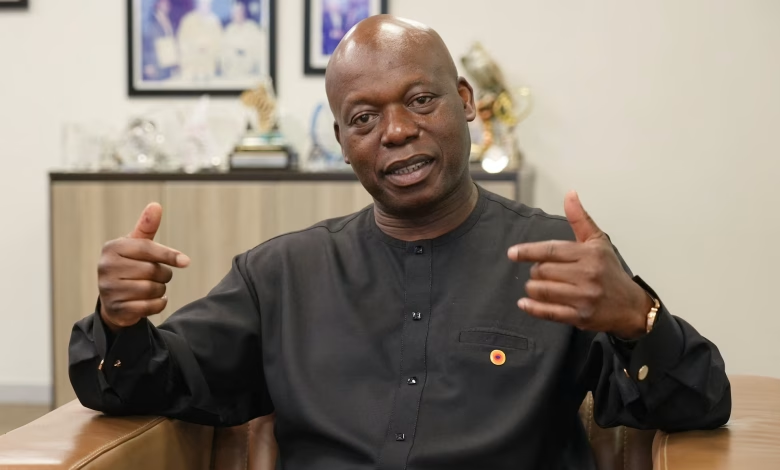
Nigeria’s indigenous energy giant, Oando, is gearing up for a massive expansion drive, with plans to secure as much as $750 million this year to fund a sweeping drilling campaign that could triple its oil output.
Speaking to Reuters, C.E.O., Wale Tinubu said the company hopes to tap renewed investor interest in West African oil producers, as global energy markets remain unsettled by tensions surrounding the Iran conflict. The fresh funding would support an aggressive drilling programme aimed at unlocking more production from Oando’s growing asset base.
Over the past decade, Oando has been among a select group of indigenous companies that stepped in to acquire Nigerian onshore oil assets from departing international majors. According to Tinubu, rising global energy prices are now creating new opportunities for regional producers to access financing.
“We’re pushing extremely hard to secure the capital needed for a large-scale drilling campaign,” Tinubu said.
Nigeria remains Africa’s largest oil producer, pumping roughly 1.6 million barrels of crude and condensate daily. Oando itself averaged just over 32,000 barrels of oil equivalent per day in fiscal 2025, but the company plans to drill up to 100 wells to significantly increase production. Much of the growth is expected from assets it acquired from international companies such as ConocoPhillips and Eni.
Tinubu noted that investors once viewed Africa as a risky destination for oil investments. However, geopolitical shocks — including the war in Iran and Russia’s invasion of Ukraine — have shifted that perception.
“Africa is actually far more stable compared to many of the regions currently facing disruptions,” he said.
The turmoil has already reshaped global crude trade routes. Tinubu revealed that more Nigerian oil cargoes are now heading to Asia, replacing supplies from the Gulf that have been disrupted by tensions around the Strait of Hormuz.
European Funding Dries Up
Despite previously raising between $3 billion and $4 billion over the last decade — largely from European banks — Tinubu said funding from Europe has almost disappeared as lenders retreat from fossil fuel projects due to climate concerns.
To fill the gap, Oando is turning to alternative financiers such as the African Export-Import Bank and the African Finance Corporation, along with global commodity traders including Vitol, Trafigura, Glencore and Mercuria.
Tinubu added that interest from Gulf-based banks, private equity firms, and hedge funds is also growing, though Africa still needs deeper pools of long-term capital to fund major energy projects.
Expansion Beyond Nigeria
Oando has already expanded operations into Angola and is exploring new opportunities in Ghana and the Ivory Coast. Tinubu believes African countries should increasingly mobilise domestic capital, including pension funds, to finance large-scale infrastructure and energy ventures.
According to him, ongoing geopolitical tensions will continue to shape global energy security and keep West Africa’s oil reserves firmly in the spotlight.
Dangote Refinery Changing the Game
Tinubu also highlighted the significance of the massive Dangote Refinery near Lagos, owned by Aliko Dangote. The 650,000-barrel-per-day refinery underscores the value of Nigeria’s resources and is already transforming the country’s fuel market.
Oando, once one of Nigeria’s biggest fuel importers, now only brings in refined products occasionally — mainly for price testing or refinery maintenance periods.
Looking ahead, the company plans to further maximise value from its assets by developing gas-based industries such as petrochemicals and fertiliser production.
Meanwhile, Oando is also working to tidy up its financial reporting after delays in filing audited accounts with the Nigerian Exchange. In August, the company’s board approved plans to launch a multi-instrument capital-raising programme of up to $1.5 billion to support its next phase of growth.