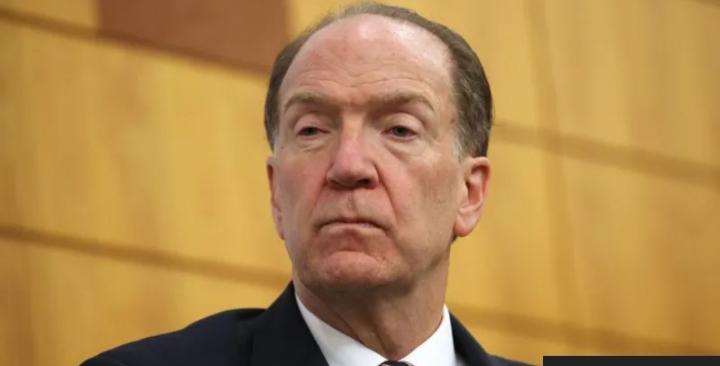
Former World Bank President, David Malpass, has accused China of worsening the global food and fertiliser shortage by stockpiling critical supplies while countries around the world struggle with rising shortages linked to the Iran conflict.
Speaking during an interview with the BBC World Service programme, World Business Report, ahead of this week’s summit between U.S. President, Donald Trump, and Chinese leader, Xi Jinping, in Beijing, Malpass urged Beijing to release some of its reserves instead of continuing to build massive stockpiles.
“China has the largest stockpile of food and fertiliser in the world,” Malpass said. “They can stop increasing those reserves.”
The former World Bank chief, who also served as the U.S. Treasury Under Secretary for International Affairs under Trump between 2017 and 2019, made the remarks as governments race to secure fertiliser supplies ahead of spring planting season.
Global supply chains have come under intense pressure following the disruption of shipping routes through the Strait of Hormuz amid tensions involving Iran, causing fears of a major food crisis.
Earlier this month, Svein Tore Holsether, the chief executive of fertiliser giant, Yara, warned that the ongoing disruption could threaten up to 10 billion meals weekly across the world, with poorer nations expected to suffer the most severe impact.
Holsether also cautioned that lower fertiliser usage could reduce crop yields globally and spark fierce competition for food supplies.
China suspended exports of several fertiliser products in March, saying the move was necessary to protect domestic supply. The restrictions added to a series of export controls Beijing has gradually imposed since 2021.
According to industry figures, China accounted for nearly 25 percent of global fertiliser production last year, exporting products worth more than $13 billion.
Malpass also questioned China’s continued classification as a developing country in global institutions such as the World Trade Organisation and the World Bank.
“They present themselves as a developing country despite being the world’s second-largest economy,” he said. “In many ways, China is already a rich nation.”
He added that Beijing could voluntarily suspend that status in international institutions.
Responding to the criticism, Liu Pengyu, spokesperson for the Chinese embassy in Washington DC, defended China’s position, insisting the country remains committed to stabilising global food and fertiliser markets.
Liu said attempts to blame Beijing for disruptions in global supply chains were misplaced, adding that China’s status as a developing country was “grounded in ample factual evidence” and remained legitimate.
Malpass also weighed in on tensions surrounding Iran and the Strait of Hormuz, warning that the international community must back efforts to restore stability in the region.
“You cannot allow a rogue state with plutonium to shut down the Strait of Hormuz,” he said.
He argued that China itself had strong economic reasons to support free navigation through the waterway because of its massive dependence on global shipping and international trade.
On the U.S. economy, Malpass predicted that inflation would continue pushing prices higher for American consumers ahead of the release of April inflation data, although he noted that recent strong employment figures showed the U.S. economy remained resilient.