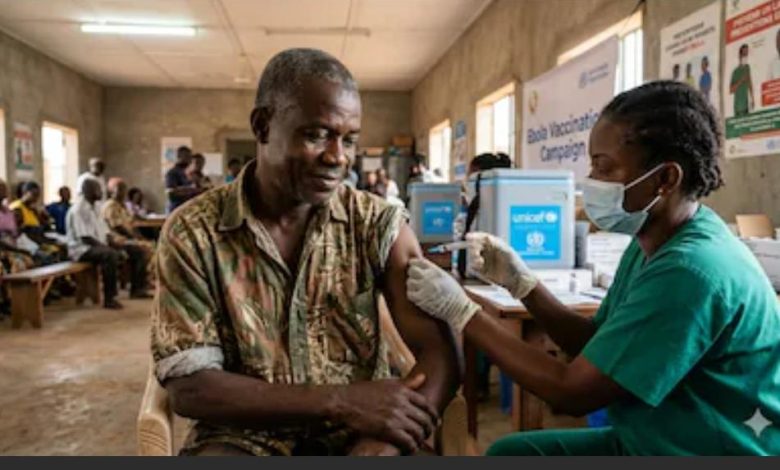
A fast-spreading Ebola outbreak in the Democratic Republic of Congo has claimed at least 80 lives, with health authorities warning that the strain behind the crisis has no approved vaccine or specific treatment.
The country’s Health Minister, Samuel-Roger Kamba, raised the alarm on Saturday in Kinshasa, describing the situation as highly dangerous due to the severity of the virus strain involved.
According to him, the outbreak is linked to the Bundibugyo strain of Ebola, which was first identified in 2007 and is known for its high fatality rate.
“The Bundibugyo strain has no vaccine, no specific treatment,” Kamba said during a press briefing. “This strain has a very high lethality rate which can reach 50 percent.”
Health officials confirmed earlier that the death toll had risen to 80 from 65 reported just a day earlier, with hundreds of suspected cases under investigation.
The outbreak has also crossed into neighbouring Uganda, where a DRC national reportedly died after being infected with the same strain.
Ugandan health authorities said the victim, a 59-year-old man, died in Kampala after being admitted earlier in the week, with his body later repatriated.
Laboratory tests confirmed he was infected with the Bundibugyo strain, which is distinct from the Zaire strain for which vaccines already exist.
Experts note that current Ebola vaccines mainly target the Zaire strain, which was first identified in 1976 and is considered even more lethal in some outbreaks.
The latest outbreak was officially declared in Ituri province in northeastern DR Congo, a region bordering Uganda and South Sudan, according to the Africa Centres for Disease Control and Prevention (Africa CDC).
Health authorities say the index case was a nurse who reported symptoms consistent with Ebola at a health facility in Bunia, the provincial capital, on April 24.
Symptoms of the disease include fever, vomiting, and internal or external bleeding, with transmission occurring through direct contact with infected bodily fluids.
Officials have warned of a high risk of further spread, especially due to frequent cross-border movement between affected communities.
The World Health Organization (WHO) said it is closely monitoring the situation, noting concerns about the scale of transmission as it prepares emergency response support, including the deployment of infection control supplies.
Ebola, which is believed to originate from animals such as bats, has caused repeated outbreaks across Africa over the past five decades, killing thousands despite advances in medical response.
The most severe outbreak in DR Congo between 2018 and 2020 killed nearly 2,300 people, underscoring the persistent threat posed by the virus in the region.