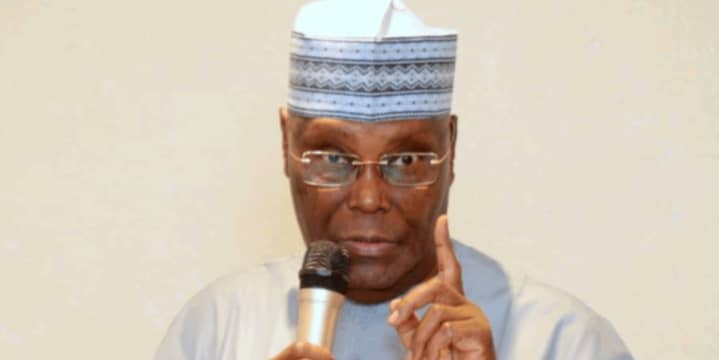
Former Vice-President and African Democratic Congress (ADC) presidential candidate, Atiku Abubakar, has challenged the Federal Government to explain why it continues to borrow heavily from the domestic market despite a sharp rise in oil revenues.
Atiku questioned the Tinubu administration’s economic policies, describing its approach as “contradictory, opaque, and bereft of fiscal discipline.”
In a statement issued on Sunday by his Senior Special Assistant on Public Communication, Phrank Shaibu, the former Vice-President said the Federal Government raised about ₦5 trillion from the domestic bond market during the first half of 2026.
According to him, the figure represents nearly 80 per cent of the amount borrowed during the same period in 2025.
Atiku argued that such aggressive borrowing would only be understandable if government revenue had fallen.
He noted that the 2026 Appropriation Act pegged the price of crude oil at $64.84 per barrel, while Brent crude traded at an average of about $92 per barrel between March 1 and July 14.
He added that Nigerian crude oil usually trades at a premium to Brent, meaning the country’s earnings could be even higher.
“This naturally raises two unavoidable questions. First, why is a government enjoying such an extraordinary oil windfall borrowing at almost twice last year’s pace as though the nation were in financial distress? Second, where is the money?” Atiku asked.
The former Vice-President said the difference between the budget benchmark and the prevailing oil price amounted to an additional $27.15 for every barrel of crude sold.
Based on an average production of 1.5 million barrels per day, he estimated that Nigeria generated an additional $42.7 million in revenue daily.
Atiku put the total additional revenue between March 1 and July 14 at about $5.76 billion, equivalent to approximately ₦7.98 trillion.
“Nigerians deserve a full accounting of this windfall. Where has the money gone? Why is there no transparent disclosure of the proceeds from excess crude sales?” he asked.
“Why is government borrowing heavily when oil revenues are significantly above budget projections?”
Atiku said previous administrations had established mechanisms for managing and reporting excess crude earnings through the Sovereign Wealth Fund and other fiscal buffers.
“Today, Nigerians have been left completely in the dark,” he added.
He further argued that a government unable to account for an estimated ₦7.98 trillion in additional oil receipts lacked the moral authority to continue increasing the country’s debt burden.
The former Vice-President also said millions of Nigerians continued to experience worsening hardship despite higher oil revenues and the removal of fuel subsidy.
He cited recent United Nations findings which, according to him, showed that about 80 per cent of Nigerians could not afford a decent meal each day.
Atiku said an ADC administration under his leadership would adopt a different approach to managing the country’s finances.
“It is increasingly evident that this administration lacks the competence, discipline, and transparency required to manage the nation’s resources,” he said.
“Rather than allowing Nigerians to benefit from favourable global oil prices, it has chosen the path of endless borrowing, mounting debt, and deepening poverty.”
He promised that an ADC government would ensure that every kobo earned above the budget oil benchmark was transparently accounted for and managed under a rules-based fiscal framework.
Rather than borrowing heavily during a period of increased revenue, Atiku said his administration would use excess earnings to reduce the country’s debt burden, strengthen fiscal buffers and invest in infrastructure, education, healthcare, agriculture and other productive sectors.
He also pledged to publish regular reports on excess crude earnings, cut the cost of governance, eliminate waste and block leakages.
According to him, borrowing would only be undertaken for productive investments capable of generating measurable economic returns, rather than to finance consumption or conceal fiscal irresponsibility.
“Nigerians deserve answers. They deserve accountability. Above all, they deserve a government that manages national wealth in the public interest, not one that presides over unprecedented opacity while asking future generations to repay debts incurred in the midst of plenty,” Atiku said.