Lagos State Governor, Babajide Sanwo-Olu, has ordered the removal of all shanties, makeshift structures and illegal markets occupying the median of the Lagos-Badagry Expressway, giving occupants 72 hours to vacate before demolition begins.
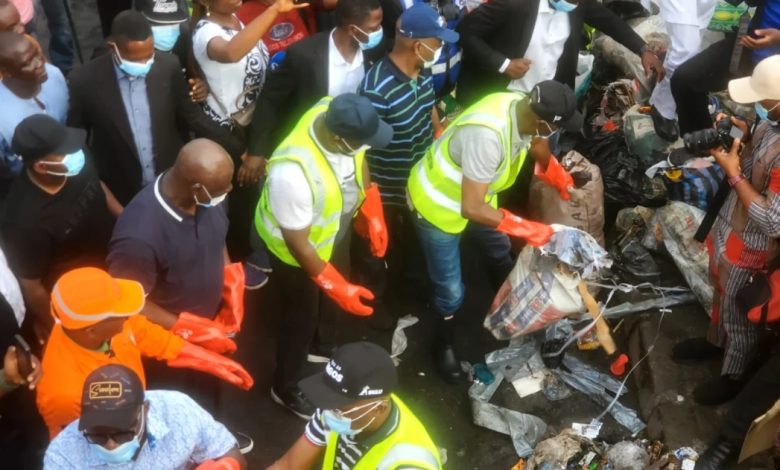
The Governor issued the directive on Saturday, June 27, 2026, during the state’s monthly environmental sanitation exercise held across communities in Surulere Local Government Area, declaring that the strategic highway corridor would no longer be allowed to deteriorate into a sprawling slum.
Speaking after the exercise, Sanwo-Olu announced that enforcement teams would move into the area from next week to commence a massive clearance operation covering the stretch from Orile-Iganmu to Okokomaiko.
“This is the final notice to everyone occupying the median of the Lagos-Badagry Expressway. From next week, we are coming to clear the entire median. Everything there will go. Every illegal structure will be removed,” the Governor said.
Sanwo-Olu stressed that the median was never designed to serve as a marketplace or residential settlement, insisting that the government would protect the massive public investment committed to the corridor.
“It is not meant to be a market. It is not meant to be a place where people erect structures. It is a highway median, and we must preserve it, especially considering the huge public investment on that corridor,” he stated.
Describing the Lagos-Badagry Expressway as an international gateway into Lagos, the Governor said the State would not sit back and allow illegal developments to take over the route.
“It’s a 10-lane highway that was built with the resources of our taxpayers. I will not fold my arms and allow them to turn that international gateway into a slum,” he said.
“This is a notice that I am giving officially to everybody on that corridor. We are starting next week, and we are going to deploy thousands of men there.”
The latest directive forms part of the Lagos State Government’s wider campaign to reclaim public spaces, enforce environmental regulations and improve security along major transport corridors across the State.
Authorities have carried out similar clearance exercises in several locations in recent months, citing concerns over illegal occupation, indiscriminate waste disposal and criminal activities linked to some of the settlements.
During the sanitation exercise, which he led alongside the First Lady of Lagos State, Dr. Ibijoke Sanwo-Olu, the Governor also highlighted ongoing efforts to improve waste management in the State.
He disclosed that Lagos would soon add 150 compactors to its waste evacuation fleet, while tricycles would be introduced to improve refuse collection in inner communities and hard-to-reach areas.
Sanwo-Olu further revealed that the State was investing heavily in long-term waste management infrastructure, including a modern material recovery and recycling facility capable of processing about 4,250 metric tonnes of waste daily.
The Governor urged residents to support the government’s environmental initiatives through proper waste disposal practices and prompt payment for waste collection services.
“Waste management is not the responsibility of government alone. It is a collective responsibility,” he said.
“Residents must also play their part by paying for waste collection services. That is what enables the PSP operators to continue providing efficient services.”
He also encouraged parents to involve their children in sanitation activities as a way of instilling environmental responsibility from an early age, describing cleanliness as essential to building a healthier and more sustainable Lagos.
Meanwhile, Lagos State Commissioner for the Environment and Water Resources, Tokunbo Wahab, said the State was moving away from the old “collect and dump” waste management model in favour of recycling and waste-to-resource initiatives.
According to him, the government is developing facilities that will convert waste into useful products while reducing pressure on existing landfill sites.
The Governor’s order was issued exactly on Saturday, June 27, 2026, with the 72-hour ultimatum expected to expire early next week.