
President Bola Ahmed Tinubu commissioned new and upgraded health infrastructure across all six geopolitical zones of Nigeria on Friday, May 30, 2026, marking the largest single-day commissioning of federal health investments in the country’s history. The nationwide programme forms part of activities marking the third anniversary of his administration and represents what the President described as the most ambitious renewal of the country’s healthcare infrastructure in a generation.
In Abuja, President Tinubu inaugurated the newly completed Bola Tinubu Specialist Complex at the Federal Medical Centre, Jabi. The two-storey facility is purpose-built for integrated specialist and VIP healthcare with eight consulting rooms, twin theatre suites, dedicated Ophthalmology and Ear, Nose and Throat departments, a fully equipped laboratory, pharmacy, nine VIP wards, four general wards, and a Private and VIP Clinic. At the Federal Ministry of Health and Social Welfare headquarters, the President also flagged off the National Emergency Medical Service and Ambulance System Emergency Response Fleet, the largest single-day deployment of emergency medical transport in Nigeria’s history.
The NEMSAS fleet comprises 145 tricycle ambulances, six boat ambulances, and 79 brand-new emergency ambulances for federal tertiary hospitals, supported by 45 laptops, 20 printers, and 320 mobile phones for digital coordination. The fleet will operate under the SAVEMAMA programme to deliver emergency obstetric and newborn care services to underserved communities including riverine, rural, and hard-to-reach areas. The President later flagged off a fleet of Compressed Natural Gas-powered ambulances for all 73 federal tertiary health facilities at a ceremony held along the Lekki-Epe Expressway in Lagos, delivered under the Nigeria Health Sector Renewal Investment Initiative.
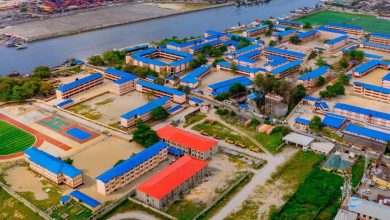
Across the zones, President Tinubu commissioned three state Polio Emergency Operations Centres in Katsina, Kano and Sokoto, expanded under eHealth Africa. In Kano, he commissioned the newly constructed Gadon Kaya Primary Health Centre under the World Bank-supported IMPACT Project, while the Aboh Primary Health Centre in Delta State was also commissioned under the same programme. Tertiary projects include a new two-storey Laboratory Complex at the University of Uyo Teaching Hospital, Akwa Ibom State, a new Administrative Complex at the University of Nigeria Teaching Hospital, Ituku-Ozalla, Enugu State, and a new Pharmacy Quality Control Laboratory at Ahmadu Bello University Teaching Hospital, Zaria. In the North-East, the President commissioned a 50-bed Mental Health and Drug Rehabilitation Centre at the University of Maiduguri Teaching Hospital. In the South-West, the Lagos Immunisation Supply Chain Hub at Federal Medical Stores, Oshodi was commissioned as the first facility under Nigeria’s new Three-Hub Immunisation Supply Chain Model.
“We are determined to give Nigerians the kind of care that, for too long, only those who could travel abroad enjoyed,” President Tinubu said. “From the rivers of the Delta to the streets of Lagos, from rural Sokoto to tertiary Maiduguri, our emergency response system must work as one. Today, we put the foundation of that system in place.” Figures released by the Federal Ministry of Health show that under the Nigeria Health Sector Renewal Investment Initiative, nearly 3,000 primary health centres have been revitalised under IMPACT, 27 Comprehensive Emergency Obstetric and Newborn Care sites established, and 1,602 Level 1 and 1,360 Level 2 health facilities revitalised across the six zones in the past two years.