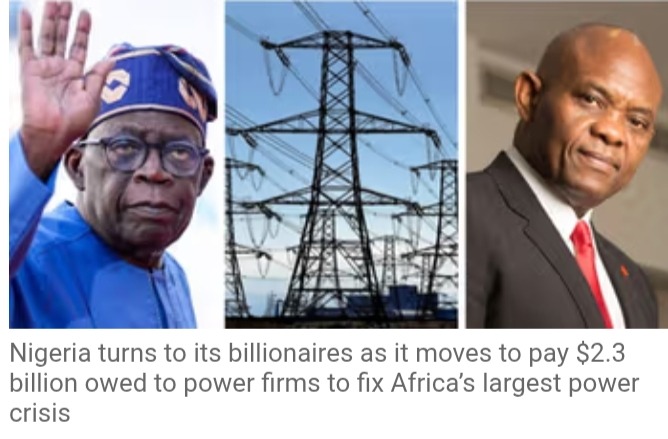
Nigeria is making a major move to rescue its troubled electricity sector, unveiling a sweeping agreement designed to clear huge payment backlogs that have long crippled power generation in the country.
The initiative, backed by the administration of Bola Ahmed Tinubu, aims to settle debts owed to electricity producers and unlock thousands of megawatts of unused power capacity.
The deal covers 15 power generation plants operated by six private companies and two government-owned entities, marking one of the most significant attempts in years to tackle the financial crisis weighing down Nigeria’s power industry.
*$2.5 Billion Plan to Revive Power Sector*
Earlier this year, the Nigerian government announced plans to raise about $2.5 billion to address structural issues across the power sector — including settling debts to generation companies and upgrading transmission and distribution infrastructure.
According to Olu Verheijen, the President’s Special Adviser on Energy, the first tranche of the financing — about ₦501 billion (around $320 million) — was issued earlier this month with a 17% yield and was fully subscribed by investors.
Officials say clearing the debts could unlock up to 4,484 megawatts of idle electricity capacity and help stabilise power supply for roughly 12 million Nigerian customers, many of whom currently endure frequent outages and grid failures.
*Major Power Companies Join the Programme*
Several of Nigeria’s biggest power generation companies have signed onto the arrangement.
Among them is Egbin Power Plc, one of the country’s largest power plants and a subsidiary of Sahara Power Group, part of the broader Sahara Group founded by entrepreneurs Tope Shonubi, Tonye Cole, and Ade Odunsi.
Also participating is Geregu Power Plc, once controlled by billionaire, Femi Otedola and known as the first electricity generation company listed on the Nigerian Stock Exchange.
The company’s majority stake was transferred in December 2025 to MA’AM Energy Limited in a $750 million transaction reportedly linked to Abdul Aziz Abubakar Yari.
Two subsidiaries of Transnational Corporation of Nigeria Plc — Transcorp Power and Afam Power — are also part of the settlement. The conglomerate is chaired by Nigerian business leader, Tony Elumelu.
Other participants include First Independent Power Limited, jointly owned by the Rivers State Government and international oil companies such as Shell, TotalEnergies, and Agip.
Also involved is Mabon Limited, which operates a hydropower concession in northern Nigeria.
On the public sector side, the Niger Delta Power Holding Company is bringing several plants into the arrangement, while Ibom Power Company, owned by the Akwa Ibom State Government, has also joined the programme.
*Infrastructure Challenges Still Loom*
Despite Nigeria’s generation potential — estimated at about 13,000 megawatts — the country’s transmission network can only carry around 25% of that capacity, according to industry estimates.
At the same time, only about half of electricity users connected to the grid are metered, a gap that continues to weaken revenue collection across the sector.
Since the privatisation of power assets in 2013, distribution companies have struggled to recover enough revenue from consumers. This has left power generation firms unable to fully pay gas suppliers, creating a chain of unpaid debts throughout the electricity market.
As a result, many Nigerian homes and businesses still rely heavily on petrol and diesel generators — or increasingly on solar systems — to cope with unreliable electricity.
Meanwhile, Nigeria is also trying to position itself as a key electricity supplier in West Africa. However, payment issues remain even within the region.
According to the Nigerian Electricity Regulatory Commission, neighbouring countries including Togo, Niger, and Benin collectively owe Nigeria about $17.8 million (₦25 billion) for electricity supplied in a recent reporting period.