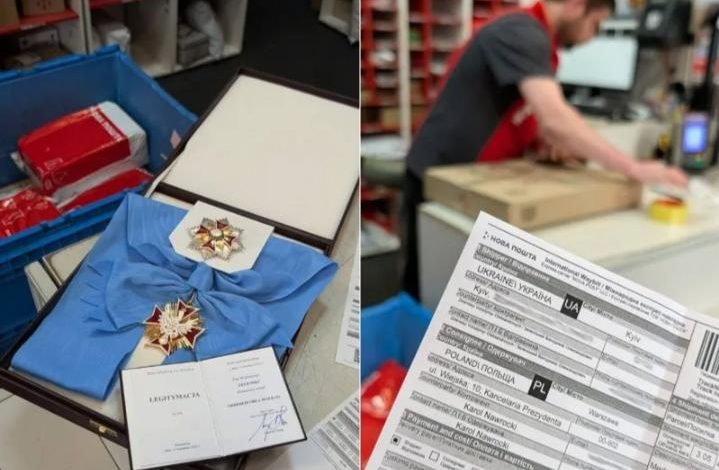
A diplomatic dispute between Ukraine and Poland has deepened after Ukrainian President, Volodymyr Zelensky announced he was returning Poland’s highest state honour, days after Polish President, Karol Nawrocki, revoked the award over a controversial World War II-era military tribute.
The latest row erupted after Ukraine renamed one of its military units in honour of the Ukrainian Insurgent Army (UPA), a nationalist force regarded by many Ukrainians as freedom fighters but blamed by Poland for the massacre of about 100,000 ethnic Poles during the Volhynia killings of 1943 to 1945.
The Order of the White Eagle, Poland’s highest state decoration, was presented to Zelensky in April 2023 by then-President, Andrzej Duda, in recognition of his leadership during Russia’s invasion of Ukraine and his efforts to strengthen ties between the two neighbouring countries.
Tensions, however, escalated after Zelensky signed a decree on May 28, 2026, renaming a Ukrainian Special Operations Forces unit after the UPA. The decision drew fierce criticism in Poland, where the group is widely regarded as responsible for genocide against ethnic Poles during World War II.
After Kyiv refused to reverse the decision, Nawrocki announced on Friday that Zelensky would be stripped of the Order of the White Eagle, describing Ukraine’s move as “outrageous”, “incomprehensible” and “deeply disappointing.”
On Saturday, Zelensky confirmed he had returned the honour.
Three senior Ukrainian officials also announced they were returning Polish state awards in solidarity with the Ukrainian President.
Many Ukrainians view the UPA, which operated during the 1940s and 1950s, as a resistance movement that fought for Ukraine’s independence against the Soviet Red Army, Nazi Germany and Polish authorities. The group’s red-and-black flag is still commonly displayed by Ukrainian troops fighting on the front lines.
Poland, however, maintains that the UPA was responsible for the genocide of around 100,000 ethnic Poles in Volhynia, now part of northwestern Ukraine, between 1943 and 1945.
In a statement posted on social media, Zelensky said Ukraine would “remain open to all meaningful formats of engagement with Poland in order to try to avoid conflicting interpretations of the difficult and painful chapters of our shared past.”
He also expressed gratitude to the Polish people for their continued support and cooperation.
Despite the diplomatic fallout, Nawrocki insisted that the disagreement would not affect Poland’s support for Ukraine in its war against Russia.
Polish Prime Minister, Donald Tusk, also appealed for restraint, warning that any conflict between Warsaw and Kyiv would only benefit Russian President, Vladimir Putin.
“Calm emotions, not stoke tensions,” Tusk wrote on social media.
Poland has remained one of Ukraine’s closest allies since Russia’s full-scale invasion, hosting hundreds of thousands of Ukrainian refugees and serving as a key logistics hub for military and humanitarian assistance.
The dispute comes as Ukraine continues its push for European Union membership, having taken part in the first stage of accession negotiations in Luxembourg earlier this week.