
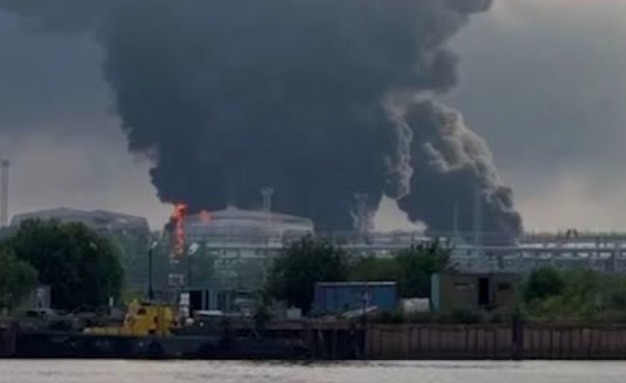
Ukraine has carried the war deep into Russian territory once again, targeting a major oil terminal in the city of St. Petersburg during an overnight drone operation that sent huge plumes of smoke into the sky.
Volodymyr Zelensky said the facility was deliberately targeted because it forms part of the infrastructure that helps finance Russia’s military campaign in Ukraine.
Ukrainian officials also claimed that a key naval base belonging to Russia’s Baltic Fleet in Kronstadt was struck during the same operation.
St. Petersburg Governor, Aleksandr Beglov confirmed that the city had come under what he described as a “massive” drone attack and acknowledged that the oil terminal had been hit, although he said there were no casualties.
Kyiv has stepped up long-range attacks against Russian energy infrastructure in recent months, with Ukrainian authorities claiming that almost 43 percent of Russia’s oil refining capacity has been disabled as a result of the campaign. The figure has not been independently verified.
Ukraine maintains that Russian oil and gas facilities are legitimate military targets because fossil fuel exports remain a major source of funding for Moscow’s war effort.
The latest strike comes just days after Russian President, Vladimir Putin, publicly acknowledged fuel shortages linked to Ukrainian attacks, a rare admission from the Kremlin leader.
On Saturday, Putin signed legislation aimed at increasing supplies to Russia’s domestic fuel market as authorities continue to battle disruptions.
Russia launched its full-scale invasion of Ukraine in February 2022.
Speaking on Saturday morning, Zelensky said the targets in St. Petersburg and the surrounding region were located around 850 kilometres, or 528 miles, from Ukraine’s border.
The full extent of the damage was not immediately clear, but footage shared by the Ukrainian President showed a drone approaching its target before thick black smoke rose into the air following the impact.
The BBC later verified that the oil terminal in St. Petersburg had indeed been struck.
Ukraine’s military described the facility as one of Russia’s largest oil terminals, with the capacity to produce 12.5 million tonnes of petroleum products annually.
The military also said the attack reached a strategic naval base used by Russia’s Baltic Fleet in Kronstadt, although Russian authorities have not publicly commented on that claim.
Governor Beglov said Russian air defences intercepted 72 Ukrainian drones over St. Petersburg and the wider Leningrad region during the assault.
He urged residents to remain indoors until the drone threat had passed and warned that mobile internet services could be disrupted.
More than five million people live in St. Petersburg.
Meanwhile, Ukraine has pushed back against Russian claims that the eastern town of Kostyantynivka has fallen under Moscow’s control.
Ukrainian military spokesman, Andriy Kovalyov, told the BBC that the town remains under the control of Ukrainian defence forces.
He acknowledged that small Russian infantry groups had managed to infiltrate some positions but insisted those units were being identified and eliminated.
His comments followed claims by Putin on Friday that Russian forces had captured Kostyantynivka in June, although the Russian leader did not provide evidence to support the assertion.
Later on Saturday, Zelensky mocked the claim in a post on Telegram, saying that if Russia truly controlled the town, Putin should have no difficulty meeting him there to negotiate an end to the war.
He added that the Russian President would not cross the front line because “the truth is very different from Putin’s words.”
Kostyantynivka forms part of Ukraine’s heavily fortified “fortress belt” in the Donetsk region, much of which remains under Russian occupation.
In its latest military update, Russia’s defence ministry said its forces had shot down more than 500 Ukrainian drones and missiles launched overnight and into Saturday morning.
The ministry accused Zelensky of trying to divert attention from one of Russia’s deadliest attacks on Kyiv on July 2 and what it described as a major Ukrainian setback in Kostyantynivka.
Moscow also warned that attacks on civilian infrastructure inside Russia would not go unanswered.