
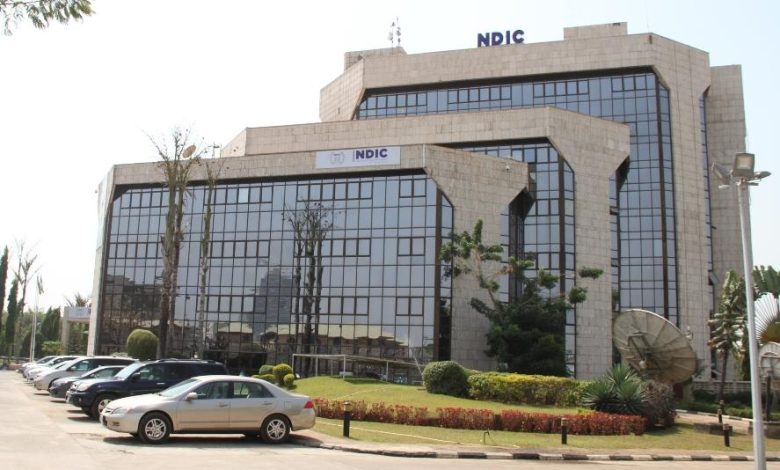
ABUJA — The Nigeria Deposit Insurance Corporation has confirmed that *NDIC shuts down Nigerian banks* this week as it begins the final process of winding up 89 failed Microfinance Banks and Primary Mortgage Banks nationwide.
The move brings an end to their existence after new operators took over their assets and liabilities. This final shutdown follows the Central Bank of Nigeria’s licence withdrawal in May 2023.
How NDIC Shuts Down Nigerian Banks Under P&A Framework
According to the Corporation, this action marks the last phase of a long-running resolution process. At the time, the apex bank revoked the operating licences of 179 microfinance banks and four primary mortgage banks over regulatory and financial concerns.
In a statement issued on Wednesday, NDIC’s Head of Communication and Public Affairs, Hawwau Gambo, explained that the clean-up exercise is being carried out under the Purchase and Assumption (P&A) framework.
NDIC Shuts Down Nigerian Banks: Official Statement
Under this arrangement, 89 newly licensed financial institutions stepped in to acquire the assets and liabilities of the failed banks and have already begun operations under new names. Gambo stated: “The exercise is designed to formally conclude the resolution process while ensuring that depositors remain protected and the country’s financial system stays stable”.
The NDIC, acting as the official liquidator, said it will now approach different divisions of the Federal High Court to obtain formal orders dissolving the defunct institutions.
State-By-State Breakdown As NDIC Shuts Down Nigerian Banks
A breakdown of the affected banks shows that Lagos State accounts for the largest number, with 27 institutions undergoing the wind-down process. Osun State follows with seven, while Anambra has six.
Furthermore, the Federal Capital Territory (FCT) recorded five affected banks, while Akwa Ibom, Ogun, and Adamawa have four each. Other states with impacted institutions include Oyo, Kaduna, Edo, and Niger, which recorded three banks each.
Meanwhile, Benue, Delta, Imo, and Ondo have two banks each on the list. Abia, Ekiti, Enugu, Rivers, Plateau, Nasarawa, Kano, Kwara, Jigawa, and Katsina recorded one affected institution each.
What Happens After NDIC Shuts Down Nigerian Banks
The NDIC stressed that the move is not a fresh crisis but the formal conclusion of a resolution that started in May 2023. Because the P&A framework was used, depositors’ funds were transferred to the new healthy institutions that took over.
As a result, customers in affected areas should still have access to banking services under the new licensed operators. The Corporation insists this process strengthens confidence by removing weak players while keeping the financial system stable.