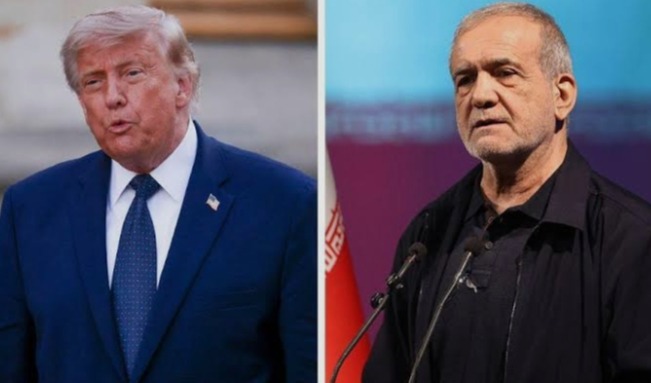
The United States and Iran have signed an initial peace agreement aimed at ending months of conflict, with both countries immediately putting the deal into effect while committing to further negotiations over Iran’s nuclear programme.
The breakthrough agreement includes the reopening of the Strait of Hormuz, a proposed $300 billion (£224 billion) reconstruction plan for Iran and the lifting of all U.S. sanctions on Tehran. However, both sides have agreed to continue negotiations on Iran’s nuclear programme during an extendable 60-day period.
U.S. President Donald Trump signed the memorandum of understanding on Wednesday during the G7 summit in France, describing the agreement as a move to prevent what he called an “economic catastrophe.”
Iranian President Masoud Pezeshkian also signed the document, with Tehran confirming the development.
Despite the agreement, Iranian parliamentary speaker and chief negotiator, Mohammad Bagher Ghalibaf, said his country remained deeply sceptical of the United States.
“Our finger is on the trigger,” Ghalibaf told state media.
“If the enemy does not understand the language of logic, we will enter again with the language of power,” he added in remarks carried by state broadcaster, Fars.
The war began on February 28 after the United States and Israel launched military operations against Iran, assassinating Supreme Leader Ayatollah Ali Khamenei and several top military commanders on the first day of the conflict.
The fighting disrupted global energy markets after Iran effectively shut the Strait of Hormuz, a strategic waterway through which about 20 per cent of the world’s oil and liquefied natural gas (LNG) supplies normally pass.
Speaking to journalists at the G7 summit in the French resort town of Evian-les-Bains, Trump said the agreement would help avert a global economic crisis.
“I didn’t want to see economic catastrophe. If you kept this going, that could have happened,” Trump said.
“All I know is every time we talked about the possibility of peace, the stock market shot up like a rocket ship. Every time we said something negative, like, guess what, we’re not going to be able to settle, it would go down very big.”
Global oil prices fell after the announcement. Brent crude dropped by about one per cent in early Asian trading on Thursday to $78.79 (£59.21) per barrel, although prices remained roughly $8 higher than before the conflict began.
Trump formally signed the agreement during a state dinner hosted by French President Emmanuel Macron at the Palace of Versailles.
Under the memorandum, both countries agreed to negotiate a final peace agreement within 60 days, with the option of extending the deadline by mutual consent.
The document states that Iran has reaffirmed its commitment not to acquire or develop nuclear weapons, one of Washington’s key conditions for ending the conflict.
It also provides that Iran’s enriched uranium will be diluted within the country under the supervision of the International Atomic Energy Agency (IAEA), the United Nations’ nuclear watchdog. The United States had initially demanded that the nuclear material be removed entirely from Iran.
The agreement further provides that ships will be allowed to pass through the Strait of Hormuz without charges for the next 60 days, although it leaves open the possibility that transit fees could be introduced afterward.
Ghalibaf warned that the waterway would not return to its pre-war status, suggesting Iran could impose charges on vessels once the 60-day period expires.
While Trump had previously vowed to eliminate Iran’s ballistic missile programme, he indicated at the G7 summit that Tehran could retain such weapons if other countries also possessed them.
The first clause of the agreement calls for the immediate and permanent cessation of military operations on all fronts, including Lebanon.
However, Israel has insisted it has no plans to withdraw its troops from Lebanon and continued military operations against Hezbollah on Wednesday.
Trump also publicly urged Israeli Prime Minister, Benjamin Netanyahu, to exercise greater restraint.
“He’s a good man, but he could do with a little softer touch,” Trump said.
“You don’t have to knock down a building every time someone walks into it that’s from Hezbollah.”
The agreement has already sparked criticism in Washington from both Republican and Democratic lawmakers.
Republican Senator, Bill Cassidy, described it as “the worst foreign policy blunder in decades,” while Senator Ted Cruz questioned the proposed $300 billion reconstruction fund, arguing that “giving billions of dollars to theocratic lunatics who want to murder us is not a good idea.”
U.S. officials, however, insisted the reconstruction fund would not require Washington to hand over money directly to Iran, explaining that third-party countries could finance approved projects if Iran complied with the agreement.
Trump also dismissed reports that the United States would be funding Iran as “a fake story,” although he acknowledged that frozen Iranian assets would eventually have to be returned.
“It’s not our money, it’s their money, and we froze it. At a certain point in time, I guess we’re going to have to give it back,” he said.
Democratic Senator Jeanne Shaheen also criticised the agreement, arguing that it failed to address Iran’s support for regional proxy groups such as Hezbollah or its missile programme.
“It’s a very bad deal. It’s not accomplished any of the aims that President Trump laid out at the start of the war,” she said.